The catalogue of shared semantic resources for interoperability

A service available to public and private entities exchanging and publishing data, to ensure that the format and meaning of the information exchanged is preserved and included in exchanges.
Search the catalog by keyword
For example: “address, person”

How it works

01

Research

Search the catalog for semantic resources useful to represent your data.

SEARCH IN THE CATALOGUE
02

Explore

Resources to understand how to contribute and use the catalogue

EXPLORE RESOURCES
03

Use

Use the validator to check that the semantic resources linked to your data are correct and consistent

USA THE INSTRUMENTS

Contribute to the catalogue

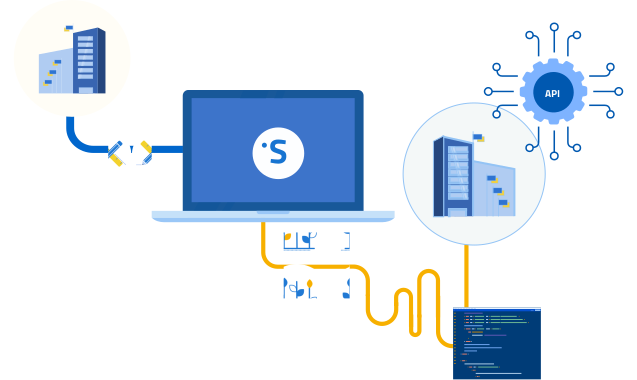
The catalogue includes semantic resources created and published by contributing entities through a technical process of automated collection.

Find out how to contribute
Contributing entities
18
+3 (2%)
compared to the previous year

Explore semantic resources

The catalog allows you to search and use multiple resources, such as controlled vocabularies, ontologies e data schemes, to represent data with semantics and make interchange semantically interoperable.
Controlled vocabularies
Lists, taxonomies and hoards used to organize terms of reference for different application domains
Currently published:
153
-45  (-22.7%)
compared to the previous year
Explore controlled vocabularies
Ontologies
Formal and shared representations of entities and their relationships by application domains of interest
Currently published:
87
-19  (-17.9%)
compared to the previous year
Explore ontologies
Data schemes
Description of data exchanged between different systems, used to define serialization and validate syntax
Currently published:
74
+0  (+0%)
compared to the previous year
Explore Data Schematics

Use the tools

Use the tools to access semantic resources and verify that the ones you publish are well described and formed for collection in the catalog.

Metadata validator

This tool allows you to facilitate the process of publishing your semantic resources in the catalog, performing validity checks of the general descriptive metadata that must be defined to ensure the discoverability of the resources. The general descriptive metadata is based, for all types of semantic tools, on DCAT-AP_IT with some variants introduced for API ontologies and schemas. A DCAT-AP_IT beta validator is also available on data.gov.it

Schema Editor

By querying Schema's semantic resources, this feature allows you to create a custom API schema that conforms to the OpenAPI standard, adapting it to your specific needs and ensuring seamless integration with your existing resources

SPARQL Endpoint

The web service that allows you to write and perform queries on structured data according to the standards of the semantic web

Repository for semantic resources

Github repository templates to organize, validate, and publish semantic resources.

Training

Participate in courses and the events organised by the Department for Digital Transformation and the National Statistical Institute (Istat) for promote knowledge and dissemination of the catalogue.
Neque blandit pellentesque nunc sed amet. Nisl, semper sed aliquam amet proin purus augue et. Neque blandit pellentesque.
Go to resource
26/09/2024
Neque blandit pellentesque nunc sed amet. Nisl, semper sed aliquam amet proin purus augue et. Neque blandit pellentesque.
Go to resource
26/09/2024
Neque blandit pellentesque nunc sed amet. Nisl, semper sed aliquam amet proin purus augue et. Neque blandit pellentesque.
Go to resource
1 2 3

Contact us

If you need more information about schema activities and projects or if you want to publish your own semantic resource, fill out the form on the contact page or write to us at info@schema.gov.it
Go to contact page
crossmenuchevron-downarrow-rightcross-circle